
Resistance bands offer a fantastic, accessible path to fitness, providing a versatile and cost-effective alternative to traditional weights; explore a resistance band guide or routine!
Many initially view them as stretching aids, but they’re capable of delivering a full-body strength training experience, adaptable to various fitness levels and spaces.
These bands come in diverse forms, materials, and resistance levels, enabling personalized workouts at home, whether seated, standing, or lying down, enhancing your fitness journey.
What are Resistance Bands?

Resistance bands are elastic bands used for strength training, rehabilitation, and stretching, offering a portable and affordable fitness solution. Unlike traditional weights, they provide variable resistance, increasing as the band is stretched – a key element found within many resistance band workout PDF guides.
These bands are typically made from latex, rubber, or thermoplastic elastomers, coming in various lengths, widths, and resistance levels, clearly detailed in most resistance band guides. They’re not merely for physical therapy; they’re powerful tools for building muscle, improving flexibility, and enhancing overall fitness.
Their versatility allows for a wide range of exercises targeting all major muscle groups, making them suitable for beginners and experienced athletes alike. Many free resistance band exercise guides demonstrate how to effectively incorporate them into your routine, proving their value beyond simple stretching. They are a compact and lightweight alternative to bulky gym equipment.
Benefits of Using Resistance Bands
Resistance bands offer a multitude of advantages, making them a valuable addition to any fitness regimen, often detailed within a comprehensive resistance band workout PDF. They are incredibly portable and lightweight, allowing for effective workouts anywhere, anytime – a benefit highlighted in numerous online resources.
Cost-effectiveness is another key benefit; they’re significantly cheaper than traditional weights or gym memberships. They provide variable resistance, accommodating all fitness levels, and are excellent for rehabilitation, building strength, and improving flexibility.
Furthermore, bands reduce the risk of injury compared to heavier weights, making them ideal for beginners. Many resistance band guides emphasize their versatility, enabling exercises for all muscle groups. They’re a fantastic way to introduce yourself to strength training, starting with low resistance and progressively increasing intensity, as outlined in many free printable guides.
Types of Resistance Bands Available
The world of resistance bands is surprisingly diverse, with options detailed in many a resistance band workout PDF. Loop bands, often sold in sets, are ideal for lower body exercises like squats and lateral walks, providing consistent tension throughout the movement.
TheraBands, typically flat and longer, are excellent for rehabilitation and upper body work, allowing for varied grip positions. Tube bands with handles offer a more traditional weight-lifting feel, suitable for bicep curls and tricep extensions.
Figure-8 bands are less common but useful for rotational movements. Stackable bands allow for customized resistance levels by combining multiple bands. Many online resources and exercise guides categorize bands by resistance level – light, medium, heavy, and extra heavy – helping users select the appropriate band for their fitness goals and experience.

Getting Started with Your Resistance Band Workout
Embarking on a resistance band journey is simple! A resistance band workout PDF can guide you, ensuring proper form and maximizing effectiveness for all fitness levels.
Choosing the Right Resistance Level
Selecting the appropriate resistance level is crucial for a safe and effective workout. A resistance band workout PDF often details band color-coding, with lighter bands (yellow, red) offering low resistance, ideal for beginners or rehabilitation exercises.
Medium resistance (blue, green) suits intermediate users, while heavier bands (black, silver) challenge advanced fitness levels. Beginners should start with lighter resistance, focusing on mastering proper form before increasing intensity.
The “rule of thumb” is to choose a band that allows you to complete 10-15 repetitions with good form. If you struggle to reach 10 reps, or the exercise feels too easy after 15, adjust the band accordingly. Many PDF guides suggest testing multiple bands to find your optimal starting point.
Remember, progressive overload – gradually increasing resistance – is key to continued progress. Don’t hesitate to combine bands for customized resistance!
Understanding Band Tension and Progression
Resistance band tension isn’t constant; it increases as the band stretches. This unique characteristic provides progressive resistance throughout the exercise range of motion, challenging muscles differently than traditional weights. A good resistance band workout PDF will illustrate this principle.
Progression is vital for continued gains. As you get stronger, simply increasing the band resistance isn’t the only option. You can also shorten the band’s length, increasing tension, or slow down the exercise tempo.
Many PDF guides recommend incorporating multiple sets and repetitions, or combining bands for a greater challenge. Focus on controlled movements and maintaining proper form throughout.
Remember to listen to your body and avoid pushing yourself too hard, too soon. Gradual progression minimizes injury risk and maximizes results, ensuring a sustainable fitness journey.
Safety Precautions for Resistance Band Training
Prioritize safety when using resistance bands. Always inspect bands for cracks, tears, or signs of wear before each workout – a comprehensive resistance band workout PDF should emphasize this. Damaged bands can snap, causing injury.
Secure the band properly; When anchoring, ensure it’s firmly attached to a stable object. Avoid using sharp edges that could damage the band. Maintain a firm grip and avoid overstretching.
Be mindful of your surroundings. Ensure you have enough space to move freely without hitting objects or people. Start with lower resistance levels and gradually increase as you gain strength.
Listen to your body and stop if you experience any pain. Proper form is crucial; consult a PDF guide or professional for guidance if needed. Warming up before and cooling down after each session is also essential.
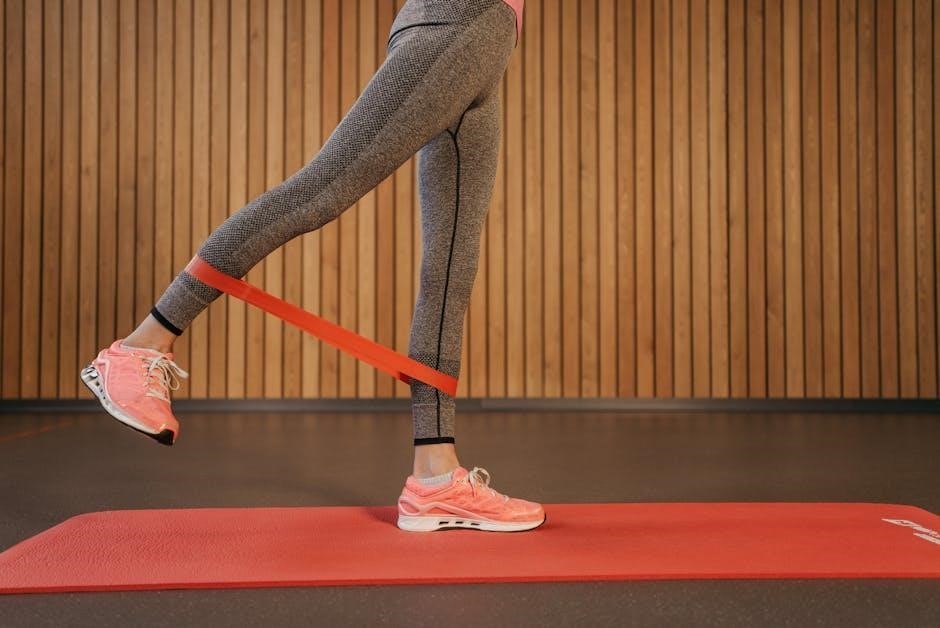
Full Body Resistance Band Workout Routine
Unlock a complete fitness experience with a resistance band workout PDF, targeting every muscle group for strength and endurance; begin your transformation today!
These routines offer versatility, allowing workouts anywhere, anytime, making fitness accessible and convenient for all levels and lifestyles.
Explore exercises for warm-ups, lower body, upper body, and core, creating a balanced and effective full-body training regimen.
Warm-up Exercises with Resistance Bands
Prioritize injury prevention and enhance performance with a dynamic warm-up utilizing resistance bands, easily found within a comprehensive resistance band workout PDF.
Begin with banded lateral walks, activating glutes and hip abductors – loop a band around ankles and step sideways, maintaining tension. Follow with banded arm circles, improving shoulder mobility; hold band with hands shoulder-width apart and rotate arms forward and backward.
Banded torso twists engage core muscles; secure band around feet, hold ends, and gently twist torso side to side. Incorporate banded pull-aparts to activate rear deltoids and improve posture – hold band with straight arms and pull apart, squeezing shoulder blades together.
These exercises increase blood flow, prepare muscles for exertion, and improve range of motion, setting the stage for a safe and effective resistance band workout. Remember to perform each exercise with controlled movements and proper form.
Lower Body Exercises
Strengthen and tone your lower body with a variety of effective exercises utilizing resistance bands, often detailed in a readily available resistance band workout PDF;
Squats with resistance bands are foundational – place band above knees and perform squats, maintaining tension throughout the movement. Enhance glute activation with glute bridges with resistance bands; position band above knees and lift hips off the ground, squeezing glutes at the top.
Lateral walks with resistance bands target hip abductors; loop band around ankles and step sideways, keeping tension on the band. For added challenge, try banded hamstring curls, anchoring the band and curling heels towards glutes.
These exercises improve strength, stability, and muscle endurance, contributing to overall lower body fitness. Focus on proper form and controlled movements for optimal results and injury prevention.
Squats with Resistance Band
Squats with resistance bands are a cornerstone lower body exercise, frequently illustrated within a comprehensive resistance band workout PDF. To perform, select a band providing moderate resistance and position it comfortably above your knees.
Stand with feet shoulder-width apart, maintaining a slight outward angle. Initiate the squat by pushing your hips back and bending your knees, as if sitting into a chair. Ensure your back remains straight and your core engaged throughout the movement.
The resistance band adds tension, activating glutes and quads more effectively; Focus on controlled descent and ascent, preventing knees from extending past toes. Aim for 3 sets of 10-15 repetitions.
This exercise enhances lower body strength, improves stability, and promotes functional movement patterns. Proper form is crucial to maximize benefits and minimize risk of injury.

Glute Bridges with Resistance Band
Glute bridges with resistance bands are a highly effective exercise for strengthening the glutes and hamstrings, often detailed in a resistance band workout PDF. Begin by lying on your back with knees bent and feet flat on the floor, hip-width apart.
Place the resistance band around your thighs, just above the knees. Engage your core and squeeze your glutes to lift your hips off the floor, creating a straight line from your shoulders to your knees.
Maintain tension in the band throughout the movement, actively pushing your knees outward against the resistance. Hold the contracted position for a second, then slowly lower your hips back to the starting position.
Complete 3 sets of 12-15 repetitions. This exercise improves hip extension, core stability, and overall lower body power, making it a valuable addition to any fitness routine.
Lateral Walks with Resistance Band
Lateral walks with a resistance band are a fantastic exercise for activating the gluteus medius, crucial for hip stability and often included in a comprehensive resistance band workout PDF. Begin by placing the resistance band around your ankles or just above your knees.
Stand with your feet hip-width apart, knees slightly bent in a quarter-squat position. Maintain this squat throughout the exercise, keeping your back straight and core engaged. Slowly step sideways, leading with one foot, maintaining tension on the band.
Follow with the other foot, keeping the band taut. Take 10-15 steps in one direction, then repeat in the opposite direction. Complete 3 sets of 10-12 steps per side.
This exercise enhances lower body strength, improves balance, and helps prevent knee injuries, making it a valuable component of any fitness regimen.
Upper Body Exercises
Resistance bands unlock a surprising range of upper body strengthening possibilities, often detailed within a comprehensive resistance band workout PDF. These exercises provide a versatile alternative to weights, allowing for effective training at home or on the go.
Key movements include bicep curls, performed by standing on the band and curling upwards, and tricep extensions, achieved by anchoring the band overhead and extending the arms. The chest press can be done by securing the band behind your back and pressing forward.
Adjusting the band’s resistance or doubling it up allows for progressive overload, ensuring continued muscle challenge. Remember to maintain proper form throughout each exercise to maximize effectiveness and prevent injury.
These exercises build strength, improve muscle tone, and contribute to overall upper body fitness.
Bicep Curls with Resistance Band
Bicep curls utilizing resistance bands are a fantastic exercise detailed in many a resistance band workout PDF, offering a convenient and effective way to build arm strength. This exercise mimics traditional dumbbell curls but with the unique benefits of constant tension provided by the band.
To perform, stand on the center of the band with feet shoulder-width apart, holding the handles with palms facing forward. Keeping your elbows close to your body, curl the band upwards towards your shoulders, squeezing your biceps at the top of the movement.
Slowly lower the band back to the starting position, maintaining control throughout. Adjusting your foot placement alters the resistance; wider stance equals less, narrower equals more.
Focus on controlled movements and proper form to maximize results and prevent injury.
Tricep Extensions with Resistance Band
Tricep extensions with resistance bands, frequently illustrated in resistance band workout PDF guides, are excellent for isolating and strengthening the back of your arms. This exercise effectively targets the triceps, contributing to toned and defined arms.
Secure the band overhead, perhaps by looping it around a sturdy door anchor or a stable overhead object. Grasp the band with one or both hands, extending your arms upwards. Keeping your elbows close to your head, slowly extend your arms fully, focusing on contracting your triceps.
Control the band as you lower it back to the starting position, resisting the pull of the band. Varying the band’s resistance level allows for progressive overload.
Maintain a stable core and proper form throughout the exercise to maximize effectiveness and minimize risk of injury.
Chest Press with Resistance Band
The chest press utilizing resistance bands, commonly detailed in resistance band workout PDF resources, is a superb exercise for developing pectoral muscle strength and definition. It mimics the traditional bench press but offers portability and adjustable resistance.
Secure the band behind your back, looping it under your armpits or around a stable object. Lie on your back with knees bent and feet flat on the floor. Grip the band ends with palms facing forward.
Extend your arms straight out in front of you, pressing the band away from your chest, focusing on squeezing your pectoral muscles. Slowly return to the starting position, controlling the band’s resistance.
Adjusting the band’s tension or using multiple bands increases the challenge. Proper form and a controlled movement are crucial for maximizing results and preventing injury.
Core Exercises
Strengthening your core with resistance bands, as outlined in many resistance band workout PDF guides, enhances stability, posture, and overall athletic performance. These exercises offer a dynamic challenge beyond traditional core work.
Resistance Band Russian Twists involve anchoring the band and twisting your torso while maintaining a stable core, engaging obliques and abdominal muscles. Resistance Band Plank with Leg Lift adds intensity to the standard plank.
Loop the band around your feet while in a plank position, then lift one leg at a time, resisting the band’s pull. This targets lower abs and glutes simultaneously. Focus on maintaining a straight line from head to heels.
These exercises are scalable; adjust band resistance to match your fitness level. Prioritize controlled movements and proper form to maximize effectiveness and minimize injury risk.
Resistance Band Russian Twists
Resistance Band Russian Twists, frequently detailed in resistance band workout PDF guides, are a highly effective exercise for targeting your obliques and rectus abdominis. This movement enhances rotational strength and core stability, crucial for various athletic activities and daily life.

To perform, securely anchor the resistance band and sit with your knees bent and feet slightly elevated. Hold the band handle(s) and lean back slightly, maintaining a straight back.

Twist your torso from side to side, bringing the band towards each hip, resisting the band’s pull throughout the motion. Control is key – avoid jerky movements.
Increase the challenge by using a heavier band or increasing the speed of the twists. Remember to engage your core throughout the exercise for optimal results and to prevent lower back strain.
Resistance Band Plank with Leg Lift
The Resistance Band Plank with Leg Lift, often illustrated in comprehensive resistance band workout PDF resources, is a dynamic core exercise that significantly boosts stability and strength. It builds upon the traditional plank by adding a leg lift, intensifying the challenge and engaging more muscle groups.
Begin in a standard plank position with the resistance band looped around your ankles. Ensure your body forms a straight line from head to heels, maintaining core engagement.
Slowly lift one leg off the ground, keeping it straight and resisting the band’s pull. Hold briefly, then lower the leg back to the starting position. Alternate legs, focusing on controlled movements.
This exercise targets your glutes, hamstrings, and lower back in addition to your core. Proper form is crucial to avoid injury; maintain a neutral spine and avoid arching your back.

Advanced Resistance Band Techniques
Resistance band workout PDF guides reveal techniques like combining bands for increased intensity, incorporating plyometrics for explosive power, and targeting specific muscle groups effectively.
Combining Bands for Increased Resistance
Resistance band workout PDF resources often demonstrate how to amplify the challenge by layering bands. This technique is ideal for progressively overloading your muscles as you gain strength, preventing plateaus and continually stimulating growth. Simply loop a lighter resistance band through the handle of a heavier band, or hold multiple bands simultaneously.
This effectively increases the overall tension, demanding greater effort from your muscles throughout the exercise. Beginners should start with a combination of a light and medium band, gradually progressing to heavier pairings as their strength improves. Always prioritize proper form over increasing resistance too quickly, as this can lead to injury.
Many downloadable guides illustrate specific exercises where band combination is particularly effective, such as squats, chest presses, and rows. Remember to adjust your technique to maintain control and stability with the added resistance.
Using Resistance Bands for Plyometrics
Resistance band workout PDF guides increasingly incorporate plyometric exercises, adding a dynamic element to traditional resistance training. Plyometrics, focusing on explosive movements, benefit from bands by increasing the demand on the muscles during both the concentric (lifting) and eccentric (lowering) phases.
For example, band-assisted jump squats require greater force production to overcome the band’s resistance, enhancing power and athleticism. Similarly, banded push-ups add a challenge to the upward phase, while increasing deceleration control on the descent.
Ensure the bands are securely anchored and appropriately tensioned for your fitness level. Prioritize landing softly to minimize impact and prevent injury. Many free resources detail specific plyometric routines utilizing resistance bands, offering modifications for varying skill levels.
Resistance Band Workout for Specific Muscle Groups
Many resistance band workout PDF resources categorize exercises by muscle group, allowing for targeted training. For legs, banded lateral walks effectively activate glute medius, crucial for hip stability. Bicep curls and tricep extensions isolate upper arm muscles, while chest presses build pectoral strength.
Core work benefits from resistance band Russian twists, increasing oblique engagement. Shoulder exercises, like band pull-aparts, improve posture and rotator cuff strength. These targeted routines often include detailed instructions and visual aids, ensuring proper form.
Exploring specialized PDFs can reveal routines focusing on specific areas like back, shoulders, or even rehabilitation exercises. Remember to adjust band resistance to match your strength level and progressively overload for continued gains.

Finding Resistance Band Workout PDFs & Guides
Numerous free resistance band exercise guides and PDFs are readily available online, offering structured routines for all fitness levels; explore r/ResistanceBand!
These resources provide convenient, printable workouts, simplifying your fitness journey and making it easier to stay consistent with your training goals.
Free Printable Resistance Band Exercise Guides
Finding readily available, free printable resistance band exercise guides is remarkably easy, offering a convenient way to structure your workouts without any cost. Many fitness websites and blogs dedicated to home workouts provide downloadable PDFs containing detailed exercise routines.
These guides typically categorize exercises by muscle group, offering variations for different resistance levels, making them suitable for beginners to advanced users. You can often find guides specifically designed for full-body workouts, upper body focus, or lower body strengthening.
Websites like Pinterest are treasure troves of visually appealing resistance band workout charts and guides. Additionally, online fitness communities, such as Reddit’s r/ResistanceBand, frequently share user-created PDFs and routines. Remember to always prioritize proper form and listen to your body when following any exercise guide.
Online Resources for Resistance Band Routines
Numerous online platforms offer a wealth of resistance band routines, extending beyond simple PDF downloads. YouTube channels dedicated to fitness frequently feature video demonstrations of exercises, providing visual guidance on proper form and technique. This is particularly helpful for beginners learning new movements.
Websites like Women’s Health and various fitness blogs curate collections of resistance band workouts, often categorized by fitness goal – such as strength building, toning, or rehabilitation. Many offer interactive workout builders, allowing you to customize routines based on your preferences.
Fitness apps also integrate resistance band exercises into their programs, providing structured workouts and tracking progress. Exploring these resources can unlock a diverse range of routines, ensuring you find options that align with your fitness level and objectives.

Resistance Band Workout Manuals & Exercise Guides
Comprehensive manuals and exercise guides are readily available, often in PDF format, to maximize your resistance band training. These resources typically detail proper form, muscle engagement, and progression strategies, ensuring safe and effective workouts. Many manufacturers, like those offering Xtreme Power Resistance Bands, include detailed instruction manuals with their sets.
PDF exercise guides frequently categorize workouts by muscle group or fitness level, offering tailored routines for beginners to advanced users. They often include visual aids, such as diagrams or photos, to demonstrate correct technique. Searching online reveals numerous free printable guides, providing accessible options for all.
These guides serve as valuable tools for structuring your workouts, tracking progress, and understanding the principles of resistance band training, ultimately helping you achieve your fitness goals.
Leave a Reply
You must be logged in to post a comment.